
The city of Shahjahanpur in India celebrates Holi with a unique procession called "Laat Saheb," where revellers hurl footwear at a man impersonating a British Lord. The tradition dates back to the 18th century and has evolved over time. The procession involves a seven-kilometer route, prayers at a temple, and a symbolic bribe offered to the police. The event is marked by strict security measures, including barricades, CCTV cameras, and the covering of mosques with tarpaulins. The procession is seen as a way to commemorate the city's history of freedom fighters and to discourage the British colonizers.

Additionally, the Haryana police and home guard personnel will be deployed for security during the elections, he said.

'The Indian Army won't induct anyone who has killed Indian soldiers.' 'That's why the army respects these reformed men so much -- they're on the frontline now, protecting India.'

Blackouts were enforced in Amritsar and Hoshiarpur's Dasuya and Mukerian areas as a precautionary measure. Electricity supply in Amritsar was restored at 11:42 pm on Monday.
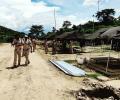
The meeting also decided that the two states will 'work out arrangement in coordination' with the centre to facilitate the functioning of the central peace-keeping force besides agreeing to continue talks to resolve the border dispute, according to top Mizoram officials.
Indian Armed Forces brought down a number of these drones using kinetic and non-kinetic means.

The shutdown was called by Kuki-Zo groups, including the Indigenous Tribal Leaders Forum (ITLF) and Kuki Students Organisation (KSO), in protest against Security Advisor Kuldiep Singh's statement about militants entering the state from outside.

Scores of people, some armed with sticks, walked in the funeral cortege of a youth killed during a Durga idol immersion procession in Bahraich amid cries for justice from the family and others on Monday, as tension escalated with shops being burnt down and angry crowds out in the streets.

'Trump has personally weighed in to overcome doubts and reservations about Pakistan among his top advisors.'

Jyoti was among 12 people who have been arrested from Punjab, Haryana and Uttar Pradesh over the past two weeks on charges of espionage, with investigators pointing at an alleged Pakistan-linked spy network operating in north India.

The Meitei group Arambai Tenggol surrendered 246 firearms to security forces in Manipur, bringing the total number of weapons surrendered to 307. The surrender follows a deadline set by Governor Ajay Bhalla for the return of illegal weapons. Arambai Tenggol's decision was influenced by assurances from the governor, including the eradication of opium poppy cultivation, implementation of border fencing, and a general amnesty for members of the group. Officials believe the surrender will contribute to restoring peace in the state, which has been rocked by ethnic violence for nearly two years. The police have urged others in possession of illegal firearms to surrender them before the deadline. Former Chief Minister N Biren Singh welcomed the surrender, calling it a "big step towards peace."
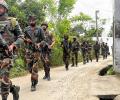
A massive multi-tier combing operation to track down a group of infiltrating terrorists continued for the fourth consecutive day in forested areas of Jammu and Kashmir's Kathua district. The operation, involving the army, NSG, BSF, police, Special Operation Group, and CRPF, is supported by helicopter, UAVs, drones, bulletproof vehicles, and sniffer dogs. The operation was launched on Sunday evening following an encounter between security forces and terrorists hiding in a nursery. Security agencies have questioned several persons in various areas and picked up three suspects for questioning.

'We need to be very vigilant as we are passing through some fraught times.'

The incident comes a day after the town was rocked by protests against the disposal plan amid a bandh call given by the Pithampur Bachao Samiti.

This is the fourth incident since the commencement of the conflict in Manipur wherein soldiers while on leave, on duty or their relatives have been targeted for nefarious interests by inimical elements.
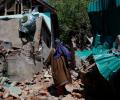
Authorities in Kashmir have launched a massive crackdown on terrorists and their sympathisers in the aftermath of the Pahalgam terror attack, razing homes of the ultras, raiding their safe havens and detaining hundreds of overground workers for questioning, officials said on Saturday.
'A man with a gun commanded respect. I thought if I also got a gun, I could save my family. With this thought, I went to Pakistan and got training there'

The Supreme Court would likely hear on Wednesday a plea of Ashoka University's faculty Ali Khan Mahmudabad against his arrest for his social media posts over Operation Sindoor.

The National Investigation Agency (NIA) has started interviewing eyewitnesses, including tourists, in connection with the deadly terrorist attack in Pahalgam, south Kashmir. The attack, carried out by terrorists from the Pakistan-based Lashkar-e-Taiba (LeT), claimed the lives of 26 people on April 22. Initial investigations suggest that five to seven terrorists were involved, aided by local militants trained in Pakistan. Security forces are conducting massive operations to hunt down the terrorists in the dense jungles of the Pir Panjal range.

The usual rush of devotees was missing this year, presumably due to the Pahalgam terror attack and the military action between India and Pakistan following it.
Holi and Friday prayers passed peacefully in Sambhal district of Uttar Pradesh amid tight security, officials said.
People in some border villages of Ferozepur district in Punjab began moving to safer areas amid soaring tensions between India and Pakistan.

People along the Line of Control and International Border in the Jammu region continue to live under the shadow of death, with unexploded mortar shells fired by Pakistani troops still embedded in farmlands and residential areas even though hostilities have stopped for nearly a week. IMAGE: Kindly note that this image has been posted for representational purposes only. Photograph: / Rediff.com Despite the May 10 understanding between India and Pakistan, locals describe the border areas as a 'death trap'. Sixty-two-year-old Balvinder Singh, who returned to his home in Pargwal sector on May 14, recounted a narrow escape. "Two shells exploded in our compound, damaging our house. Three more landed on our farmland. We were terrified and told our family to stay away from the fields until the Army could help," Singh told PTI. Army engineers later came to the village and safely defused the unexploded shells, bringing a temporary sense of relief. "Fear is writ large on the faces of people to these death traps in border hamlets", he said. Scenes of destruction are evident rooftops torn apart, broken houses, windows punctured by shrapnel, and carcasses of cattle lying in pools of blood. The acrid smell of gunpowder still lingers in the air. Sardar Gurmeet Singh faced a similar ordeal. His family could not re-enter their home as a live mortar shell had sunk into the compound in a village close to the International Border. "The army's bomb disposal squad removed it after four days, allowing us to finally enter, back home," he said. Indian Army engineers have launched a sweeping clearance operation across border districts, defusing over 80 unexploded shells in the past five days -- including 6 in Pargwal, 19 in Rajouri, 42 in Poonch, and 12 along the IB. "These shells, mostly 120 mm calibre, have a range of 15 to 30 km and pose a serious threat to both civilian and military targets," an Army officer said. "Many of them were fired by Pakistan during recent hostilities." On May 7, the Indian Army launched Operation Sindoor, conducting precision strikes on nine terror hubs in Pakistan and Pakistan-occupied Jammu and Kashmir (PoJK) in response to the April 22 terror attack in Pahalgam that killed 26 people, most of them tourists. The subsequent retaliation by Pakistan pushed the region to the brink of war. From 7 to 10 of May, 27 civilians were killed and over 70 injured in Pakistani shelling in the Jammu region. Farid Din Gujjar, a resident near the border, expressed fear about returning to his fields. "Several shells created deep craters in our paddy land. We cannot resume work until all unexploded ordnance is cleared. It's a death trap," he said. Army units, in coordination with Jammu and Kashmir Police, have evacuated high-risk zones and issued stern warnings to residents not to touch any suspicious objects or unexploded shells. In one major operation, 42 live shells were safely destroyed in the Poonch villages of Jhullas, Salotri, Dharati and Salani. "All safety protocols were followed. The shells posed a serious danger to local lives," an Army spokesperson said, calling the effort a 'continued commitment to protect civilians and restore normalcy'. Poonch saw the vast majority of deaths due to shelling. Security officials said that Pakistan used a mix of mortar shells, armed drones, and missiles during the shelling spree, specifically targeting civilian habitations and border towns in Jammu, Samba, Kathua, Rajouri, and Poonch. As clearance operations continue, the border residents are slowly returning to their homes, but with caution, fear, and lingering uncertainty about shelling that may yet happen in the future.
'Many of them are mutilated beyond recognition. Every day an encounter takes place.' 'Bastar has been burnt to ash.'

An Indian Air Force plane will bring the bodies of the Maharashtra pilgrims killed in a bus accident in Nepal to Nashik on Saturday, officials have said.

The security review was held after the February 20 ultimatum given by the governor to everyone holding illegal and looted arms to surrender.

Survivors of the 2006 Mumbai train blasts express shock and disappointment after the Bombay High Court acquitted all 12 accused, citing lack of evidence. They feel justice has not been served after 19 years.

Police also announced a bounty of Rs 20 lakh for information leading to the neutralisation of terrorists involved in the gruesome killings.
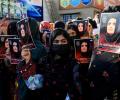
'When so many young Baloch men and women are willingly volunteering as fighters and even suicide bombers.'

Amid concerns of espionage, the Rajasthan administration has intensified security measures along the India-Pakistan border, with authorities in Jaisalmer and Sri Ganganagar banning the use of Pakistani SIM cards.
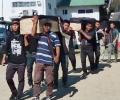
'There are 7,000 guns which are in the hands of the armed militia of the Kuki and Meitei communities.'
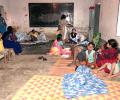
Several areas in Muslim-majority Murshidabad, including Suti, Dhulian, Jangipur and Shamsherganj, have witnessed violent protests against the Waqf (Amendment) Act that spiralled into communal violence, sparking the exodus.

A villager was killed and three others were injured in shelling by Pakistan in forward areas of Jammu and Kashmir's Poonch and Rajouri districts early Friday morning, prompting Army troops to retaliate. The shelling also caused significant damage to property, with many houses and hundreds of vehicles affected. The firing and shelling were directed at areas in Rajouri, Poonch, and Jammu districts, apart from Kashmir's Kupwara and Baramulla districts, overnight.
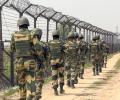
The United States has issued an advisory cautioning against travel to the immediate vicinity of the India-Pakistan border and the Line of Control due to terrorism and the potential for armed conflict and to the provinces of Balochistan and Khyber Pakhtunkhwa.
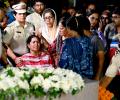
The dastardly dimensions of the attack are gradually sinking in even as the Government of India announced its immediate diplomatic and other retaliatory measures. It is generally expected to be followed up with punitive military action across the LoC, sooner than later, observes Mohammad Sayeed Malik, the distinguished commentator on Kashmir affairs.
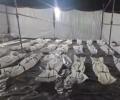
In one of the deadliest blows to Naxalites in Chhattisgarh, security forces on Sunday gunned down 31 rebels, including 11 women, in a fierce encounter in the state's Bijapur district, police said.

India on Thursday night swiftly foiled Pakistan's attempts to hit various key Indian installations including military stations at Jammu, Pathankot and Udhampur with drones and missiles, the defence ministry said.

At least three BSF personnel sustained bullet injuries after gunmen fired at security forces in Manipur's Thoubal district, police said on Thursday.

Major Gogoi might well have saved protesters' lives by opting for a human shield to force his way through the mob. But he incalculably damaged the army's reputation, not just in Kashmir, but anywhere that video is seen.

A leading Kuki-Zo organisation in Manipur has demanded a judicial probe into the killing of 10 youths in a gunfight with the CRPF, raising questions about the paramilitary force's neutrality. The Indigenous Tribal Leaders' Forum (ITLF) also reiterated its demand for a separate administration for the Kuki-Zo community in the state, where ethnic violence between Kuki tribals and Meiteis has claimed over 250 lives since May last year. The ITLF claimed the post-mortem reports showed the youths were shot from the back, suggesting they were not engaged in a gunfight when they were killed. The organisation further alleged that CRPF personnel stationed nearby refused to intervene during an attack on Zairawn village, where a woman was killed. The ITLF has called for a political solution to the ongoing conflict, urging the Union Home Minister to consider a separate administration for the Kuki-Zo people.
 © 2026 Rediff.com - Advertise with us - Disclaimer - Privacy Policy - Sitemap - Feedback - About us - Terms of use - Grievances